The History of Downtown Pittsburgh
Written by Nevaeh Williams
The skyline of Downtown Pittsburgh stands as a testament to the hard work of laborers and immigrants who came as steel workers, helping build American railroads, bridges and skyscrapers, eventually taking root and calling Pittsburgh home. These men ran the furnaces, worked the barges and rivers to transform Pittsburgh into the industrial powerhouse we know it as today.
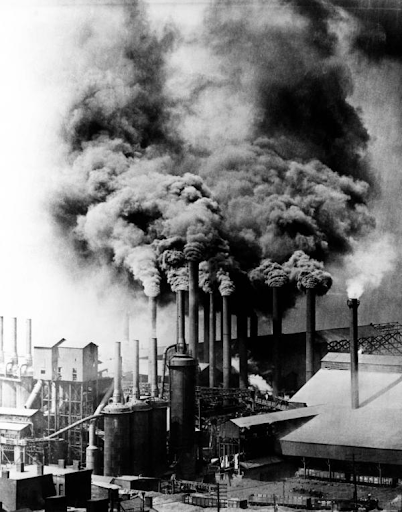
Image Courtesy of Corbis Bettmann, 1906
However, industrial success came at a cost. By the turn of the 20th century, Downtown Pittsburgh was defined by a dense layer of smoke and soot blanketed over the hodgepodge of heavy industry buildings and housing.
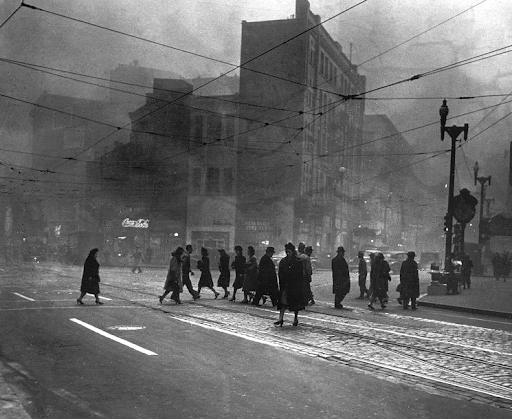
Downtown 1940, at noon.
Despite the diminished quality of life from the severely degraded environment, Pittsburgh’s skyline evolved. The construction of the first two big skyscrapers in Art Deco style was the Grant Building (1928), which was built of limestone, granite, and brick, and the Gulf Tower (1932) out of limestone. Shortly thereafter in 1945, Mayor David Lawrence, who grew up at the point, wanted to transform the city. So teaming up with Richard B. Mellon, heir to the powerful Mellon family, began Pittsburgh’s first Renaissance.
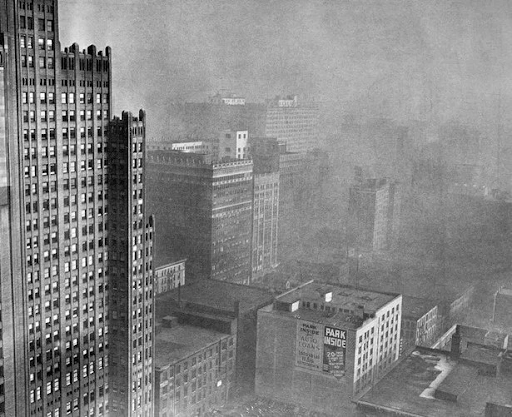
Downtown 1940, at noon. (images courtesy of University of Pittsburgh's Historic Image Collection)
In the 1940s, companies faced severe difficulty recruiting talent personnel; the dense smoke layer made for a poor quality of life. However, with Mayor Lawrence and Richard Mellon working together, thanks to Mellon’s influence, the Allegheny Conference established an agenda for renewal of the city. One of the most notable accomplishments was the creation of Point State Park. Having removed the busy roads to make room for a 36-acre park, the redevelopment of nearby land led to the creation of the Gateway Center.
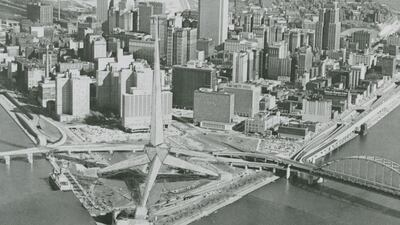
The trilon was never built; instead city planners placed a fountain at Point State Park. courtesy of (Allegheny Conference on Community Development Photographs, Detre Library & Archives, Heinz History Center)
These projects helped transform Pittsburgh from one of the most polluted industrial cities in America into a national model of redevelopment.
By the 1970s and 80s, Renaissance II was already underway. Out of this second renaissance, the Federated Building (1982), PPG Place (1984), and the Highmark building (1988) were built, gradually tapering towards the point. It was during this time that city leaders began their revitalization strategy, heavily investing in arts and culture. By converting unused areas and housing into theaters, restaurants, and nightlife, emerged the Pittsburgh Cultural District.
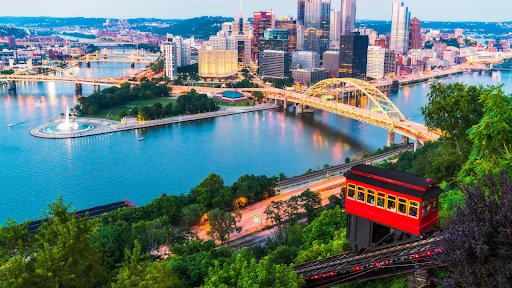
Pittsburgh is a city that continues to evolve, continually adapting to new economic and social changes. Today, our Golden Triangle stands as a testament to Pittsburgh’s past laborers, immigrants, steel mills, and factories. Now a hub for innovation, technology, education, healthcare, and culture, Pittsburgh has always been defined by reinvention, and downtown has been at the heart of that transformation.